Owning a holiday home in Cádiz from the UK: the 90/180-day rule and renting it out while you’re away
The 90/180-day rule for UK owners of a holiday home in Cádiz, as GOV.UK explains it, and how to plan your own stays around holiday-letting the home.
In this article
You own a house or flat in the Bay of Cádiz and would love to spend more of the year there. Since Brexit, though, the time a British visitor can stay is limited, and the rest of the year the home sits empty. This guide explains the 90/180-day rule as GOV.UK sets it out, and how to combine your own stays with letting the home while you are away.
Reviewed November 2026. Sources at the end.
What is the 90/180-day rule?
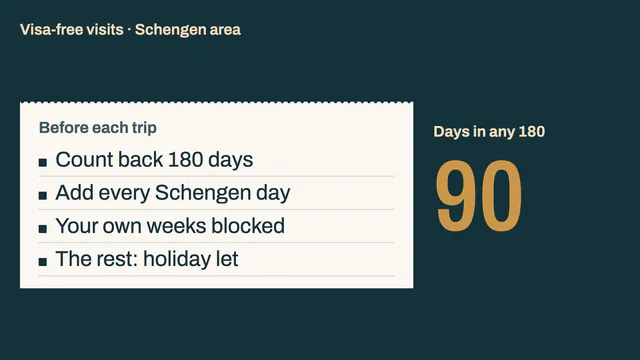
According to GOV.UK, you can travel without a visa to the Schengen area, which includes Spain, for up to 90 days in any 180-day period. It is not 90 days per calendar year, and it is not 90 days per country:
- It is rolling. Visits to Schengen countries in the 180 days before you travel count towards your 90 days. To check a trip, count back 180 days from the day you plan to leave and add up the days you spent in the Schengen area.
- It covers the whole Schengen area. If you also travel to France, Portugal or any other Schengen country, GOV.UK says your whole visit must stay within the 90-day limit.
- Residence permits are different. If you are in Spain with a residence permit or long-stay visa, that time doesn’t count towards the 90 days.
It is not only for British visitors. According to the European Commission, non-EU nationals can stay in the Schengen area for a total of 90 days in any 180-day period, and the US Department of State says the same for travellers with a US passport: up to 90 days in any 180-day period.
An example. You stay in your home in Rota from 1 March to 29 April: 60 days. You want to come back in June. On any day in June, the 180 days before it still include those 60 days, so you can spend up to 30 days in June before you reach 90, as long as you haven’t been anywhere else in the Schengen area.
What happens if I overstay?
GOV.UK warns that if you overstay the 90-day visa-free limit, you may be banned from entering Schengen countries for up to 3 years. If exceptional reasons force you to stay longer, it says you must apply to the immigration authorities (Extranjería).
What changes at the border: EES and ETIAS
According to GOV.UK, the EU’s Entry/Exit System (EES) started on 12 October 2025. It is a digital border system: you may be asked to register your fingerprints and a photo when you arrive, there is no cost, and your EES record is valid for 3 years. GOV.UK also says that British nationals legally resident in Spain with a biometric residence card don’t need to register with EES.
GOV.UK also says that the EU expects to start the European Travel Information and Authorisation System (ETIAS) from autumn 2026, that it will announce the date before launch, and that a €20 fee will apply. Check the GOV.UK page before you travel.
Does owning a home in Spain let me stay longer?
GOV.UK’s guidance makes no exception for property owners. The only point it makes about your own home is practical: at border control you may need proof of address if you are staying at your own property. Staying longer than 90 days in 180 needs a visa or residence, and that is a different decision, with different tax consequences. GOV.UK suggests checking the other country’s residence rules, because you can be resident in both the UK and another country.
How do I combine my stays with renting the home out?
The 90/180-day rule turns your calendar into two parts: the weeks you spend there, and the months the home would otherwise sit empty. Those months can earn as a holiday let, as long as the home is registered in the Andalusian Tourism Register. We explain the licence on our holiday rental licence in Andalusia page.
In practice, it works like this:
- Choose your weeks early. Tell us the dates you want for yourself or your family and we block them. A week that guests have already booked is no longer free.
- Let the busy months earn. In the beach towns, July and August are the strongest months, so you may prefer to keep spring or autumn for yourself. In Jerez, May is the strongest month, with the Horse Fair.
- Keep the home cared for while you are away. With the Completo plan we handle every guest, Hola Limpio cleans after each stay and sends you photos, and we register every guest with the Spanish authorities.
- Know the tax side. While you live in the UK, Spanish non-resident tax applies to the rent, and imputed income applies to the days the home isn’t let. We explain it in renting out your property in Spain as a UK owner.
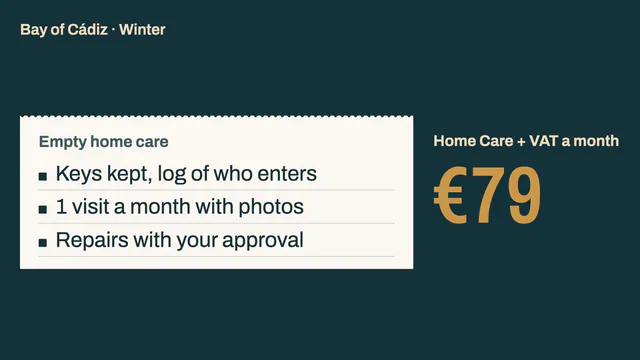
Not ready to let it? We can simply look after it between your stays, with home care for owners abroad: your keys kept, regular visits with photos and the home made ready before you arrive. Both options, side by side, are on our page on property management for owners abroad.
Our plans are 15, 20 or 25 % + VAT of what you receive for the nights, and if there are no bookings, we don’t charge. See our pricing, estimate your income with the holiday let income calculator, read the step-by-step guide for owners in the UK, or ask for a free assessment.
General information, reviewed November 2026. This is not tax or legal advice: check your case with a gestor or tax adviser.
If your home is in the city of Cádiz, see our page on holiday rental management in Cádiz.
Frequently asked questions
What is the 90/180-day rule?
According to GOV.UK, UK citizens can travel without a visa to the Schengen area, which includes Spain, for up to 90 days in any 180-day period. Visits to Schengen countries in the 180 days before you travel count towards your 90 days.
How long can I stay in Spain without residency?
Up to 90 days in any 180-day period, counting all Schengen countries together, according to GOV.UK. Staying longer needs a visa or residence permit; time on those doesn’t count towards the 90 days.
How long can second home owners stay in Spain?
If you are a UK citizen without a Spanish visa or residence permit, up to 90 days in any 180-day period, counting every Schengen country together, according to GOV.UK. Owning a second home in Spain does not change that limit.
Does owning a property in Spain let me stay longer?
GOV.UK’s guidance makes no exception for property owners. The only thing it says about your own home is that at the border you may need proof of address if you are staying at your own property.
What happens if I overstay?
GOV.UK warns that if you overstay the 90-day visa-free limit, you may be banned from entering Schengen countries for up to 3 years.
Can I let my home while I’m in the UK?
Yes, if it is registered as a holiday let in the Andalusian Tourism Register. A management company can look after guests, cleaning and the guest register while you are away, and you block the dates you want for yourself.
Sources
- GOV.UK: Spain travel advice, entry requirements
- European Commission: visa policy, short stays in the Schengen area
- US Department of State: the Schengen area
- GOV.UK: EU Entry/Exit System
- GOV.UK: Living in Spain
- GOV.UK: Tax on foreign income, if you’re taxed twice
- Junta de Andalucía: tourist-use dwellings, frequently asked questions (in Spanish)
Is your flat in the Bay of Cádiz?
Free assessment of your flat