Renting out your property in Spain as a UK owner: tax, rules and management (2026)
UK owner with a home in Cádiz? How Spanish non-resident tax, UK tax and the guest register work when you let your property, from official sources.
In this article
- Do I need a licence to rent out my property in Spain?
- What are the legal requirements once guests arrive?
- How much tax do you pay on a rental property in Spain as a UK resident?
- What tax obligations do UK residents have at home?
- I live in the US: how is my Spanish rental income taxed?
- What does a management company do, and what doesn’t it do?
- Frequently asked questions
If you live in the UK and own a house or flat in Cádiz, El Puerto de Santa María, Rota, Puerto Real or Jerez, letting it to holidaymakers while you are away can make sense. Before the first guest arrives, three things need to be in order: the licence, the guest register and your tax on both sides. This guide sets out what the official sources say, in plain English.
General information, reviewed November 2026. Sources at the end.
Do I need a licence to rent out my property in Spain?
Yes, if you let it to tourists in Andalusia. What people call a “holiday rental licence” is the registration of the home as a vivienda de uso turístico in the Andalusian Tourism Register (RTA), run by the Junta de Andalucía and governed by Decree 28/2016. Each Spanish region has its own rules; this article covers Andalusia.
According to the Junta:
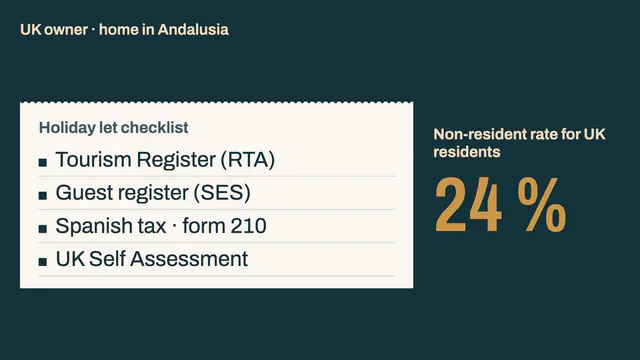
- Registration is done online with a declaración responsable, which must be filed with a digital certificate. It is free of charge.
- With the declaration you attach an up-to-date nota simple from the Land Registry and a certificate from the owners’ association’s secretary or administrator showing its express approval for tourist use.
- You then download the registration resolution with your code, in the format VUT/CA/00000 for the province of Cádiz. That code must appear in every advert.
Your town hall has a say too. Decree 28/2016 allows town halls to limit tourist homes by building or area. In Jerez, for example, the town hall’s questions and answers (13 April 2026) say that in urban land they are allowed on the ground floor of blocks of flats, in detached or terraced houses and in buildings without horizontal division run by their owner. You can read more on our page about the holiday rental licence in Andalusia.
The owners’ association matters as well. According to the Horizontal Property Act on the BOE, you need its express approval first, and since 3 April 2025 an agreement to approve, limit, set conditions on or ban the activity needs three fifths of the owners, who must also hold three fifths of the shares.
What about a long-term let instead? According to article 1.2 of Decree 28/2016, homes let for more than two months in a row to the same tenant fall outside the tourist-home rules. That is a different kind of letting, with different rules.
What are the legal requirements once guests arrive?
Two duties come with every booking:
- Guest register. According to Royal Decree 933/2021, every guest’s details are reported to the Spanish Ministry of the Interior through the SES.HOSPEDAJES platform, immediately and within 24 hours at most. Reporting late is classed as a minor infringement.
- Registration code. The VUT code goes in every listing and advert, and Decree 28/2016 also asks for official complaint forms to be available in the home.
If a company runs the day-to-day for you (keys, reception, guest care, cleaning), the Junta says it must be listed as the operator of the home.
Insurance is not on the list of requirements in Decree 28/2016, but it is worth checking that your policy fits a holiday let: see holiday home insurance in Spain.
How much tax do you pay on a rental property in Spain as a UK resident?
As someone who is not tax resident in Spain, you pay non-resident income tax (IRNR) on the rent. According to the Agencia Tributaria:
- The rate is 19 % for residents of the EU, Iceland, Norway and Liechtenstein, and 24 % for everyone else. The UK is not on that list.
- As a general rule, the tax is charged on the full income, with no expenses deducted. Residents of the EU, and of EEA states with an effective exchange of tax information, may deduct expenses linked to the rental. Residents of other countries, the UK included, may not.
- The return is form 210. Under Order HAC/623/2026, from 1 January 2027 rental income is declared in the first 20 days of April of the year after it was earned, whether you declare it separately or grouped. Rents from October 2026 onwards already follow this new calendar.
The Agencia Tributaria also explains that a home let without hotel-type services is taxed as income from property. If the letting comes with services typical of the hotel trade, such as a restaurant, cleaning or laundry, it can be treated as a business with a permanent establishment in Spain. Where your case falls is a question for your gestor.
When you use the home yourself. For the days it is not let, non-residents declare an imputed income: 1.1 % or 2 % of the cadastral value, depending on the property’s cadastral valuation, in proportion to the days it was not let, and taxed at the same 19 % or 24 % with no expenses deducted.
What tax obligations do UK residents have at home?
According to GOV.UK, if you are UK resident you normally pay UK income tax on foreign income, and that includes rental income on overseas property. You usually report it in the foreign section of your Self Assessment return. If you don’t normally send a return, GOV.UK says you must tell HMRC by 5 October after the tax year in which you had the income.
To avoid paying twice on the same income, the UK has a double taxation agreement with Spain, and you can usually claim Foreign Tax Credit Relief for the Spanish tax when you report the income. GOV.UK points out that you may not get back the full amount of foreign tax you paid.
I live in the US: how is my Spanish rental income taxed?
In Spain, it works as it does for a UK owner. According to the Agencia Tributaria, residents outside the EU, Iceland, Norway and Liechtenstein pay non-resident income tax at 24 % on the full rental income, with no expenses deducted, and declare it on form 210.
In the US, according to the IRS, US citizens and resident aliens are taxed on their worldwide income, and the filing rules are generally the same whether you live in the United States or abroad. If you paid foreign income tax and are taxed in the US on the same income, the IRS says you may be able to take a credit or an itemised deduction for it; individuals claim the foreign tax credit with Form 1116. The IRS also lists an income tax treaty between the United States and Spain, from 1990, and a protocol amending it, from 2013.
General information, reviewed November 2026. This is not tax or legal advice: check your case with a gestor or a US tax adviser.
What does a management company do, and what doesn’t it do?
A good holiday let manager takes the day-to-day off your hands, but some things always stay with you as the owner.
What we do at Orilla Host:
- Check that the registration is in order and that the VUT code is right in every listing.
- Report every guest on SES.HOSPEDAJES (with the Completo plan, or as a separate service).
- If your home is not registered yet, we offer a free feasibility study and can handle the registration for you. Ask us for a quote.
- Send a monthly report and payout, and an annual report for your tax adviser.
What we don’t do:
- File your Spanish or UK tax returns, or give tax or legal advice.
- Guarantee income or a licence.
If you would rather not let it, or only for part of the year, see our page on property management for owners abroad.
Our plans are 15, 20 or 25 % + VAT of what you receive for the nights, and if there are no bookings, we don’t charge. You can see them on our pricing page, compare them in holiday rental management fees, and check what the platforms take in how Airbnb’s fee is charged and when you get paid. For a figure for your own home, try the holiday let income calculator or ask for a free assessment.
General information, reviewed November 2026. This is not tax or legal advice: check your case with a gestor or tax adviser.
If your property is in Jerez, see our page on holiday rental management in Jerez.
Frequently asked questions
Do I need a licence to rent out my property in Spain?
If you let it to tourists in Andalusia, yes: it must be registered as a vivienda de uso turístico in the Andalusian Tourism Register (RTA), and the registration code must appear in every advert. Each Spanish region has its own rules.
How much tax do UK residents pay on rental income in Spain?
According to the Agencia Tributaria, non-residents outside the EU, Iceland, Norway and Liechtenstein pay 24 % non-resident income tax on the full rental income, with no expenses deducted. It is declared on form 210.
Do I also pay tax in the UK?
According to GOV.UK, if you are UK resident you normally pay UK tax on foreign income, including rent from overseas property, and report it on your Self Assessment return. You can usually claim Foreign Tax Credit Relief, although you may not get back the full amount of the Spanish tax.
I live in the US: how is my Spanish rental income taxed?
In Spain, according to the Agencia Tributaria, residents outside the EU, Iceland, Norway and Liechtenstein pay 24 % non-resident income tax on the full rental income, with no expenses deducted, and declare it on form 210. In the US, according to the IRS, US citizens and resident aliens are taxed on their worldwide income, and you may be able to claim a foreign tax credit for the Spanish income tax with Form 1116. The IRS also lists an income tax treaty between the United States and Spain.
What happens to tax when I use the home myself?
According to the Agencia Tributaria, for the days an urban property is not let, non-residents declare an imputed income of 1.1 % or 2 % of its cadastral value, in proportion to those days, taxed at 19 % or 24 %.
Does a management company file my Spanish tax returns?
We don’t. We report every guest to the authorities, keep the registration code in every listing and give you a monthly report and an annual report for your tax adviser, who files your returns.
Sources
- Junta de Andalucía: tourist-use dwellings, frequently asked questions (in Spanish)
- Decree 28/2016, consolidated text (Junta de Andalucía, in Spanish)
- Jerez town hall: questions and answers on tourist-use dwellings, 13 April 2026 (in Spanish)
- Act 49/1960 on Horizontal Property, consolidated text (BOE, in Spanish)
- Royal Decree 933/2021, guest registration (BOE, in Spanish)
- Agencia Tributaria: non-resident income tax on tourist apartments (in Spanish)
- Agencia Tributaria: income from let property, non-residents (in Spanish)
- Agencia Tributaria: imputed income from urban property for own use (in Spanish)
- Agencia Tributaria: changes to form 210 deadlines, Order HAC/623/2026 (in Spanish)
- GOV.UK: Tax on foreign income
- GOV.UK: Tax on foreign income, if you’re taxed twice
- GOV.UK: Living in Spain
- IRS: U.S. citizens and resident aliens abroad
- IRS: Foreign tax credit
- IRS: About Form 1116, Foreign Tax Credit
- IRS: Spain tax treaty documents
Is your flat in the Bay of Cádiz?
Free assessment of your flat