Modelo 210 in English: how UK owners file Spanish tax on holiday-let income
Modelo 210 explained in English for UK owners of a holiday let in Spain: what you need, what each part of the form asks, how to pay and the deadlines.
In this article
If you let your home in Cádiz while you live in the UK, you will meet modelo 210 (form 210) every year. It is the return for non-resident income tax, and the Agencia Tributaria’s pages about it are in Spanish. This is a practical guide to the form itself, in plain English. For the tax rates and what is taxed, read renting out your property in Spain as a UK owner first: we don’t repeat it here.
General information, reviewed November 2026. Sources at the end.
What is modelo 210?
Modelo 210 is the Spanish return for non-resident income tax without a permanent establishment (IRNR). As a UK owner, you use it for two things: the rent from letting your home, and the imputed income for the days it is not let.
The form asks you to choose the type of income (tipo de renta) with a code. According to the Agencia Tributaria’s instructions:
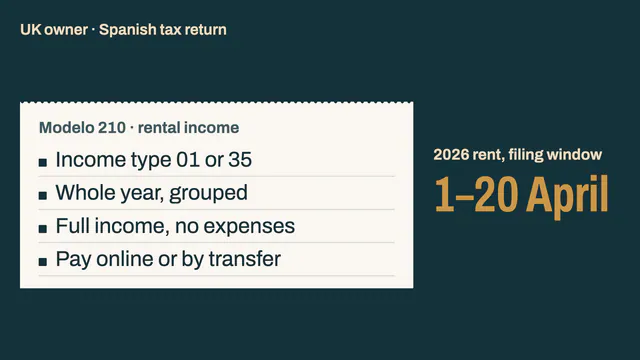
- 01: income from letting a property.
- 35: income from letting a property when you declare rent from several payers who are not obliged to withhold tax.
- 02: imputed income from an urban property, for the days it is not let.
Which code fits your holiday let is worth checking with your gestor.
What do I need before filing?
You need a way to identify yourself and, for the online route, a way to sign. According to the Agencia Tributaria:
- Spanish tax number (NIF). The form asks for the NIF assigned to you in Spain, if you have one. If you file on paper as the taxpayer without a NIF, the predeclaration form has a button to obtain an identification code instead.
- Your UK tax number. There is a separate field for the tax number in your country of residence.
- Online filing needs an electronic signature certificate accepted by the Agencia Tributaria. Individuals can also use the Cl@ve system.
- Paper filing without a certificate is possible: you fill in the predeclaration form on the Agencia Tributaria’s website, print it, write your NIF on every copy and sign it by hand.
- The cadastral reference of the home (referencia catastral), which the form asks for.
Who can file. In general, the return can be made by the taxpayer, their representative or a person jointly liable. For rental income (types 01 and 35), the instructions say that since 16 December 2023, when Order HFP/1338/2023 came into force, only the taxpayer can make it (Agencia Tributaria, modelo 210 instructions, “Persona que realiza la autoliquidación”, in Spanish). The Agencia Tributaria also describes filing through a collaborator (colaboración social) or with a power of attorney as general routes; ask your gestor which applies to you.
What does each part of the form ask?
Here are the parts of modelo 210 as the Agencia Tributaria’s instructions name them, with what each one asks. We give the Spanish name so you can find it on the form.
- Persona que realiza la autoliquidación (person making the return): the NIF and name of whoever files, and in what capacity. For rental income, that is you.
- Devengo (accrual): whether you group the income, the period (the whole year or a quarter) and the accrual date.
- Renta obtenida (income received): the income type code (01, 35 or 02, above) and the currency.
- Contribuyente (taxpayer): your details, including your Spanish NIF if you have one, your tax number in the UK, date and place of birth, country of tax residence, address and phone numbers.
- Representante (representative), or an address in Spain for notices: only if you have appointed a representative, or want to give a Spanish address for letters.
- Pagador (payer): details of who paid the rent. The instructions say not to fill it in for types 02 and 35.
- Situación del inmueble (location of the property): the cadastral reference.
- Determinación de la base imponible (tax base): for rent, the gross income, the deductible expenses and the tax base; for imputed income, its own tax base.
- Liquidación (calculation): common to every type. It applies the tax rate and gives the result to pay.
A worked example from the Agencia Tributaria. A person resident in Germany earned €1,000 a month in rent in 2024. Grouped for the year, the gross income is €12,000, the example counts no expenses, and at 19 % the result to pay is €2,280. The same page notes that the rate for residents outside the EU, Iceland, Norway and Liechtenstein is 24 %, which is the one that applies to you as a UK resident.
How do I pay, and when?
You can pay in several ways. According to the Agencia Tributaria:
- At a bank in Spain that is a collaborating entity of the Agencia Tributaria.
- With an NRC (a payment reference) through the Agencia Tributaria’s payment gateway: by direct debit from an account at a collaborating entity, or by credit or debit card or Bizum. You need a certificate, an electronic DNI or Cl@ve Móvil.
- By direct debit (domiciliación), for returns filed online. Since 1 February 2024 it can also be from an account at a non-collaborating bank in the SEPA area, with an electronic SEPA mandate.
- By transfer from abroad, in euros, using only the payment identifier as the reference, and from an account that is not at a collaborating entity. The identifier is valid for 30 days.
Deadlines for rental income. Under the changes in Order HAC/623/2026, the Agencia Tributaria gives these periods:
- Grouped for the year (2026 and later): from 1 to 20 April of the following year, so 2026 rent is due from 1 to 20 April 2027. Direct debit: from 1 to 15 April.
- Declared separately, rent earned up to September 2026: the first 20 days of April, July, October and January.
- Declared separately, rent earned from October 2026: from 1 to 20 April of the following year.
What about the days I use the home myself?
You declare imputed income for them, with income type 02. We explain how it is worked out in renting out your property in Spain as a UK owner. For imputed income from 2026 onwards, the Agencia Tributaria says the filing period runs from 1 April to 31 December of the following year, so for 2026 it opens on 1 April 2027.
If you want to understand how your own stays fit around letting the home, see the 90/180-day rule for UK owners.
What does Orilla Host do, and what doesn’t it?
We don’t file your modelo 210 or give tax advice. What we do is make the figures easy for whoever files it: a monthly report with every booking and cost, a payout every month, and an annual report for your tax adviser.
Our plans are 15, 20 or 25 % + VAT of what you receive for the nights, and if there are no bookings, we don’t charge. See our pricing, estimate your income with the holiday let income calculator, or ask for a free assessment.
General information, reviewed November 2026. This is not tax or legal advice: check your case with a gestor or tax adviser.
If your home is in Jerez, see how we work in holiday rental management in Jerez.
Frequently asked questions
Is there a modelo 210 form in English?
The Agencia Tributaria pages on modelo 210 that we checked are in Spanish. The only English example we found is for dividends received by a company, not for rental income. This guide explains each part of the form in English.
Can I reduce the tax on my Spanish rental income?
Not with expenses, if you live in the UK. According to the Agencia Tributaria, only residents of the EU and of EEA states with an effective exchange of tax information may deduct expenses; everyone else pays on the full income. What GOV.UK describes is relief at home: you can usually claim Foreign Tax Credit Relief for the Spanish tax on your UK return.
Do I need a gestor or fiscal representative?
The Agencia Tributaria says appointing a representative is compulsory in the cases set out in article 10 of the non-resident income tax law and voluntary in all others. For rental income, its instructions say that since 16 December 2023 only the taxpayer can make this return. The pages do not require a gestor; ask one whether your case needs a representative.
When is modelo 210 due for 2026 rental income?
According to the Agencia Tributaria, if you group the whole year in one return, from 1 to 20 April 2027. Rent from October 2026 declared separately also goes to 1 to 20 April 2027.
Do I file modelo 210 if I only use the home myself?
Yes, for the imputed income. According to the Agencia Tributaria, non-residents declare it with income type 02, and for 2026 the filing period runs from 1 April to 31 December 2027.
Sources
- Agencia Tributaria: modelo 210 procedure (in Spanish)
- Agencia Tributaria: modelo 210 instructions (in Spanish)
- Agencia Tributaria: ways of filing modelo 210 (in Spanish)
- Agencia Tributaria: ways of filing and paying modelo 210 (in Spanish)
- Agencia Tributaria: form and filing deadlines (in Spanish)
- Agencia Tributaria: example, income from letting a home (in Spanish)
- Agencia Tributaria: income from let property, non-residents (in Spanish)
- GOV.UK: Tax on foreign income, if you’re taxed twice
Is your flat in the Bay of Cádiz?
Free assessment of your flat